

Let’s talk about something most people would rather Google in private than bring up at dinner.
Your sex life is not what it used to be. Maybe the desire faded. Maybe the performance got unreliable.
Maybe both of you still love each other, but the bedroom has gone quiet in a way that neither of you knows how to talk about.
And maybe you’ve already tried the obvious stuff. The little blue pill. The supplements with the embarrassing names at the gas station counter.
The “just relax and it’ll come back” advice from people who clearly aren’t dealing with what you’re dealing with.
Here’s the good news. There’s a category of treatments that finally takes sexual wellness seriously, for both men and women, and it doesn’t rely on the same tired plumbing-based logic that the pharmaceutical industry has been selling for the past 25 years. It’s called peptide therapy. And the peptides being used for sexual health right now are doing something genuinely different from anything that came before them.
This is the honest, no-fluff guide to the best peptides for sex, what they actually do, who they work for, and why they might be the missing piece of the puzzle.
First, What Even Is a Peptide?
Before we get into the specific compounds, let’s clear up the basics, because the word “peptide” gets thrown around in wellness marketing like it’s some kind of magic spell.
Peptides are short chains of amino acids. Amino acids are the building blocks of proteins, and when you string a small number of them together, you get a peptide. Your body makes peptides naturally, all day every day, and they act as signaling molecules. Think of them as tiny messengers that travel between cells and tell them what to do. Some peptides regulate hormones. Some control immune responses. Some manage tissue repair. And some, as it turns out, control the parts of your brain and body that govern sexual desire and arousal.
When we talk about peptide therapy, we’re talking about synthetic versions of these natural compounds, designed in a lab to mimic the signaling that your body already does, but in a more targeted and predictable way. Peptide synthesis as a science has come a long way, and the peptides being used for sexual wellness today are highly specific, well-studied, and increasingly available through qualified medical providers.
The reason peptides are so exciting in the sexual wellness space is that they work upstream. They target the brain, the hormones, and the signaling cascades that actually create desire and arousal, rather than just forcing a downstream physical response. That’s a fundamentally different approach from what most people are used to, and the results reflect it.
Now let’s get into the actual compounds.
PT-141 (Bremelanotide): The Brain-First Sex Peptide
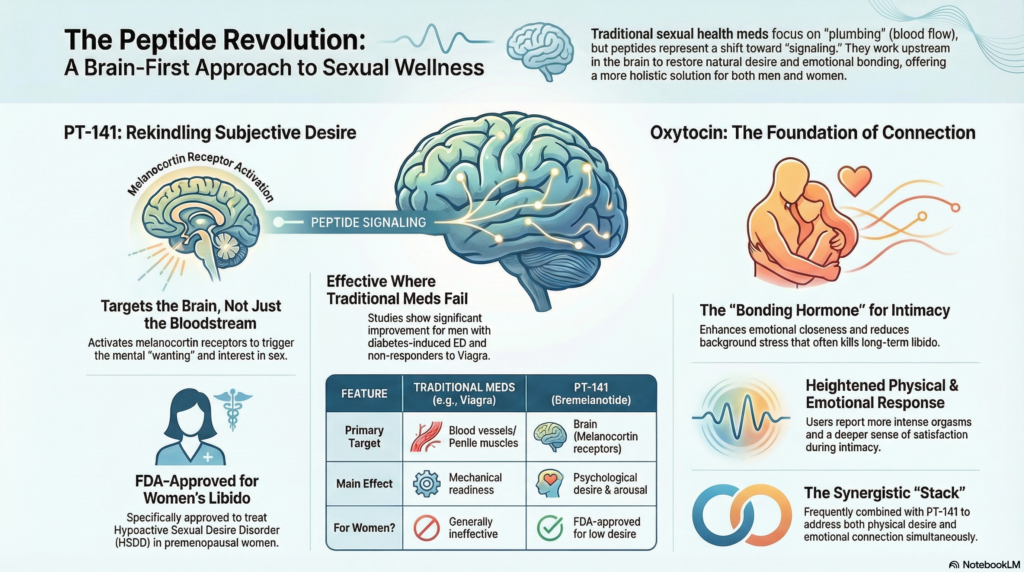
If there’s a king of sexual wellness peptides right now, it’s PT-141, also known by its scientific name bremelanotide. This is the compound that’s getting the most attention, and for good reason. It does something that no other widely available sexual health medication does: it works on the brain instead of the bloodstream.
Here’s the science. PT-141 is a synthetic melanocortin agonist. That means it activates a specific group of receptors in your brain called melanocortin receptors, which play a central role in sexual response.
When these receptors fire, they trigger a chain reaction that includes the release of nitric oxide (which yes, helps with the physical side of things by relaxing penile muscles and increasing blood flow), but more importantly, they generate the actual subjective experience of desire. The wanting. The interest. The feeling of being turned on by your partner instead of just trying to be turned on.
Compare this to PDE-5 inhibitors like Viagra (sildenafil) and Cialis. Those drugs only work on blood flow to the penis. They do nothing for desire. They do nothing for the brain. They just make it easier for a physical response to happen if the mental piece is already in place. PT-141 addresses both halves of the equation, and that’s what makes it different.
What the Research Actually Shows
The clinical evidence for PT-141 is solid, and it’s worth knowing the actual numbers instead of just taking marketing claims at face value.
In studies on men, the erectile response triggered by PT-141 was statistically significant compared to placebo at doses above 7 mg, with the first erection typically occurring around 30 minutes after administration. In one trial, 34% of men in the bremelanotide group reported significantly better outcomes (including the ability to achieve and maintain an erection sufficient for intercourse) compared to just 9% in the placebo group. That’s a meaningful gap.
Even more interesting is the research on combination therapy. Studies have shown that PT-141 works synergistically with sildenafil. When men who weren’t responding well to Viagra alone were given a combination of PT-141 (7.5 mg) and sildenafil (25 mg), the erectile response was significantly greater than what sildenafil produced on its own. Researchers described it as a clinically significant enhanced erectile response. For men who had basically given up on PDE-5 inhibitors, this is a big deal.
There’s also a Phase IIB trial that looked at PT-141 in men with diabetes-induced erectile dysfunction over a three-month period. Diabetic ED is historically one of the hardest forms to treat because the underlying nerve and vascular damage doesn’t respond well to standard interventions. The trial showed significant improvements in International Index of Erectile Function (IIEF) scores, which is the standard measurement tool for ED outcomes. That gives real hope to a population that’s often been told there’s not much that can be done.
For women, the story is arguably even bigger. Bremelanotide was approved by the FDA in 2019 specifically to treat hypoactive sexual desire disorder (HSDD) in premenopausal women. That’s the actual approved indication. For the first time in the history of women’s sexual medicine, there’s a drug that targets the core complaint that millions of women have been raising for decades, which is essentially: I used to want sex, I don’t anymore, and I want my desire back.
How PT-141 Is Used
PT-141 is typically administered in one of two ways. The most common is a subcutaneous injection, which means a small needle into a fatty area like the abdomen or thigh. It sounds intimidating if you’ve never done it, but it’s similar to what diabetics use for insulin and most people get comfortable with it quickly. The other delivery method is intranasal administration, where the peptide is given as a nasal spray. The nasal route is convenient and the onset is fast, with effects kicking in within minutes.
The standard protocol is to take PT-141 about 45 minutes before planned sexual activity. The maximum recommended dose is one per 24 hours, and no more than eight doses per month. Some users report effects lasting up to 72 hours, though the peak window is generally in the first several hours after dosing.
What’s worth understanding is that PT-141 doesn’t feel like Viagra. People who use it successfully don’t describe a sudden mechanical readiness. They describe something more like interest returning. A warmth and curiosity that they hadn’t felt in a while. Their partner suddenly looks more attractive. Touch feels better. They find themselves initiating instead of being talked into it. That’s the brain-based difference in action.
The Side Effects Worth Knowing
No honest article about peptides should skip the side effects, and PT-141 has a few you should know about.
The most common is nausea, which affects roughly 10% of users and can be significant for some people. Flushing happens in about 20.3% of users. Injection site reactions occur in around 13.2%. Headaches show up in about 11.3%, and vomiting in just under 5%. Most of these are manageable, but the nausea is the one that some people find genuinely difficult, so it’s worth knowing going in.
There’s also a small, transient increase in blood pressure with PT-141, typically around 6 mmHg systolic and 3 mmHg diastolic. The effect peaks within 4 hours of dosing and returns to baseline within 8 to 10 hours. For people with healthy cardiovascular systems, this isn’t a problem. For people with uncontrolled hypertension or existing heart disease, PT-141 is contraindicated and should not be used. This is one of the main reasons working with a qualified medical provider matters so much. You need someone to check your blood pressure and your cardiovascular health before starting treatment.
Off-Label Use for Men
One thing to know is that while PT-141 is FDA-approved for HSDD in premenopausal women, its use in men for erectile dysfunction is technically considered off-label. Off-label prescribing is extremely common in medicine and is perfectly legal. It just means a drug is being prescribed for a condition outside its original FDA approval, based on clinical experience and supporting research. A huge percentage of prescriptions written every day are off-label, including many medications you’ve probably taken yourself. The point is that you want a knowledgeable provider who understands the research and can decide whether PT-141 is appropriate for your specific situation.
Oxytocin: The Bonding Peptide That Changes the Whole Equation
The second peptide that belongs at the top of any best-of list for sexual wellness is oxytocin. And while PT-141 gets most of the headlines, oxytocin might be the one that actually changes the most relationships.
Oxytocin is a peptide hormone that your body produces naturally during intimate moments. Hugging, kissing, sex, breastfeeding, even deep conversation can trigger its release. It’s been called the bonding hormone, the cuddle hormone, the love hormone, and a few other names that all sound vaguely embarrassing but point at the same thing: oxytocin is what makes you feel connected to another person.
In a sexual wellness context, oxytocin does several things at once. It enhances emotional connection and intimacy with your partner. It boosts sexual arousal. It improves the orgasmic response, often making orgasms feel more intense and emotionally satisfying. And it reduces the kind of background stress that often kills libido in long-term relationships. For couples who love each other but feel emotionally disconnected during sex, oxytocin can be transformative.
Who Oxytocin Is For
Oxytocin is particularly useful for people who are dealing with stress-related drops in libido, couples whose physical intimacy has eroded over years of life pressure, individuals who feel emotionally distant from their partners even when they don’t want to be, and anyone who wants to enhance the bonding side of sex rather than just the mechanical side.
It’s also worth mentioning that oxytocin works beautifully alongside PT-141. PT-141 handles the desire side. Oxytocin handles the connection side. When you combine the two, you’re addressing the full picture of what makes sex meaningful, which is wanting your partner and feeling close to them at the same time. That combination is the foundation of most modern sexual wellness protocols.
How Oxytocin Is Used
Oxytocin is typically administered as either a nasal spray or a subcutaneous injection, and the response is generally fast. The nasal spray is the more popular delivery method because it’s simple, painless, and effective. People often use oxytocin shortly before intimate time with their partner, similar to how PT-141 is timed.
Side effects with oxytocin are generally mild compared to many sexual wellness medications. Most people tolerate it well, which is part of why it’s become such a popular addition to peptide protocols.
Why Peptides Are Genuinely Different from Everything That Came Before
It’s worth taking a moment to talk about why peptides as a category are getting so much attention right now, because the hype is real but it’s also grounded in something legitimate.
For most of modern medicine, sexual dysfunction has been treated like a mechanical problem. Something is broken, here’s a chemical to force it to work. That approach gave us drugs like Viagra and Cialis, which absolutely have their place but which also leave huge gaps. They don’t help with desire. They don’t help with bonding. They don’t help with the emotional and psychological side of sex. And for women, they barely help at all.
Peptides take a completely different approach. Instead of forcing a single physical response, they work with the body’s natural signaling systems. They activate receptors that already exist in your brain and body, and they trigger cascades that already happen in healthy sexual function. They’re not overriding your biology. They’re nudging it back toward what it’s supposed to be doing.
This matters for a few reasons. First, peptides tend to have a more natural feeling effect than traditional medications. People often describe peptide-based interventions as feeling more like a return to how things used to be, rather than a chemical override. Second, peptides are generally well tolerated, with side effect profiles that are often milder than older medications. Third, peptides can be combined and stacked to address multiple aspects of sexual wellness at once, which is why most modern protocols use more than one.
The other thing that makes peptides different is that they fit into a bigger philosophy of functional medicine, which is the idea that you should be treating root causes instead of just symptoms. If your libido is low because your hormones are out of balance, fixing the hormones makes more sense than masking the symptom. If your sexual response is fading because your stress is sky-high, addressing the stress (with help from oxytocin and lifestyle changes) is smarter than just popping a pill. Peptides slot into this approach naturally because they work with the body instead of against it.
The Benefits of Peptides for Sexual Wellness
Pulling all of this together, here’s what peptides can actually do for your sex life when used correctly and under the right medical supervision.
Enhanced libido. This is the headline benefit, and it’s the biggest reason most people start exploring peptide therapy in the first place. PT-141 in particular is built specifically to rekindle desire, and for people who’ve watched their libido fade over the years, getting it back can feel like a revelation.
Improved erectile function. PT-141 doesn’t just boost desire. It also triggers the nitric oxide pathway that helps with the physical side of erections. For men who’ve struggled with ED, especially men who didn’t respond well to PDE-5 inhibitors, this dual action can be a game changer.
Better hormonal balance. Oxytocin and other peptides interact with your hormone systems in ways that support overall sexual health and vitality. Hormones are the foundation of desire, energy, and mood, and getting them into balance has knock-on effects that go far beyond the bedroom.
Stronger emotional connection. Oxytocin’s bonding effects can transform the emotional quality of intimacy, especially in long-term relationships where the chemistry has quieted down. Feeling close to your partner during sex matters as much as the physical experience, and oxytocin is the peptide that targets that directly.
Improved relationships. When sexual wellness improves, relationships generally improve with it. Sex isn’t the only thing that matters in a partnership, but when it’s not working, it puts pressure on everything else. Restoring it can lift the whole dynamic.
A non-invasive, lower-risk option. Compared to a lot of traditional sexual health interventions, peptides are non-surgical, generally well tolerated, and can be discontinued at any time without lasting effects. For people who want to try something effective without committing to anything permanent, peptides offer a low-friction entry point.
Address root causes, not just symptoms. This is the functional medicine philosophy in action. Instead of just papering over the issue, peptides work with the body’s existing systems to restore healthier function. That tends to produce better long-term results than symptom-only approaches.
Are Peptides Right for You?
Peptide therapy for sexual wellness is one of the most promising options available right now, but it’s not for everyone, and it’s not a DIY project. If any of this sounds like it might fit your situation, the right move is to talk to a qualified healthcare provider who has actual experience with peptide therapy. That might be a urologist for men, a gynecologist or functional medicine practitioner for women, or a clinic that specializes in sexual wellness for both.
Your provider should do a real workup. They should check your cardiovascular health, review your medications, look at your hormone levels, and have a real conversation with you about your goals and your relationship situation. Peptides work best when they’re part of a thoughtful, individualized plan, not when they’re handed out like candy. Stay away from anyone who wants to prescribe them without that kind of evaluation, and absolutely stay away from gray-market peptide vendors online. This is something you’re putting into your body. Quality and sourcing matter.
Once you’re working with the right provider, the experience tends to be straightforward. You’ll get a treatment plan, you’ll learn how to administer the peptides, and you’ll start to see how your body responds. Most people who go through this process and stick with it report meaningful improvements in their sex lives, often within the first few weeks.
The Bottom Line
For decades, the conversation about sexual wellness has been stuck in the same narrow lane. Erections for men, frustration for women, and a one-size-fits-all approach that left huge numbers of people behind. Peptides like PT-141 (bremelanotide) and oxytocin represent something genuinely new. They target the brain. They work with the body’s natural signaling. They address desire, connection, and physical response all at once, and they do it in a way that feels more like restoring something lost than forcing something artificial.
If your sex life has gone quiet and you’re tired of being told to just communicate better or just take a pill, peptides are worth looking into. They’re not magic, and they’re not a substitute for a healthy relationship or a healthy lifestyle. But they’re also not snake oil. They’re a real, science-backed, increasingly mainstream option that’s helping a lot of people rediscover something they thought they’d lost for good.
Talk to a real provider. Ask the real questions. And don’t accept that flat, fading intimacy is just how things have to be from here on out. The science has finally caught up to what people have been asking for, and the best peptides for sex are the ones that take desire as seriously as they take performance.
Both halves matter. You deserve treatments that understand that.

Written by a Real Coach, Not an AI
David WygantDating coach for over 20 years, David has personally helped 1.7 million people navigate dating, relationships, and confidence. He tests every platform and product he reviews himself before recommending it. His advice has been featured on NBC, MTV, USA Today, the New York Post, and the LA Times.
More about David's experience →